
Industrial Automation and Controls
NEMA vs. IEC: Why the Difference Exists, and Should You Care?
Open two industrial control panels and you may find very different motor starters doing essentially the same job. One may be a larger NEMA starter with broad application margin. The other may be a compact IEC contactor selected closely for the motor and switching duty. Both can be correct.
The useful question is not which one is better
NEMA and IEC represent different approaches to the same engineering problem. Traditional NEMA equipment is organized around standardized starter sizes. IEC equipment is generally selected more closely around the load, operating duty, and utilization category.
The practical question is whether the selected device, protective components, and application remain a valid system.
Two approaches to motor control
NEMA approach
Standardized starter sizes can simplify selection and provide useful application margin. A facility may also standardize around fewer starter sizes for emergency replacement and storeroom planning.
Representative family: Eaton Freedom NEMA contactors and starters, including non-reversing and reversing configurations and overload options.
IEC approach
Selection is commonly tied more closely to the motor, load type, switching duty, operating voltage, and utilization category. The result can be a compact, modular installation with more application-specific choices.
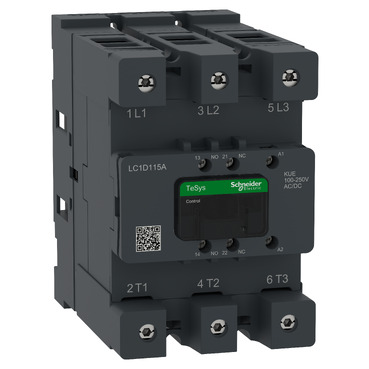
Representative family: Schneider Electric TeSys Deca contactors, offered for motor and non-motor loads in non-reversing and reversing arrangements.
Product families are examples, not drop-in replacement recommendations. Final selection depends on the complete application and the manufacturer's current selection data.
The amp rating does not tell the whole story
An 18 A marking does not by itself establish suitability. Schneider Electric's own TeSys example shows why: an LC1D18 contactor is associated with 18 A motor duty in AC-3, while the same family can have a different current rating for resistive AC-1 service.
Load type and switching conditions change what the contacts must make and break. Always compare the correct utilization category, motor rating, voltage, coil, poles, duty, and environmental conditions.
Review Schneider Electric's explanation of AC-1 and AC-3 utilization categories.
A NEMA starter by sight
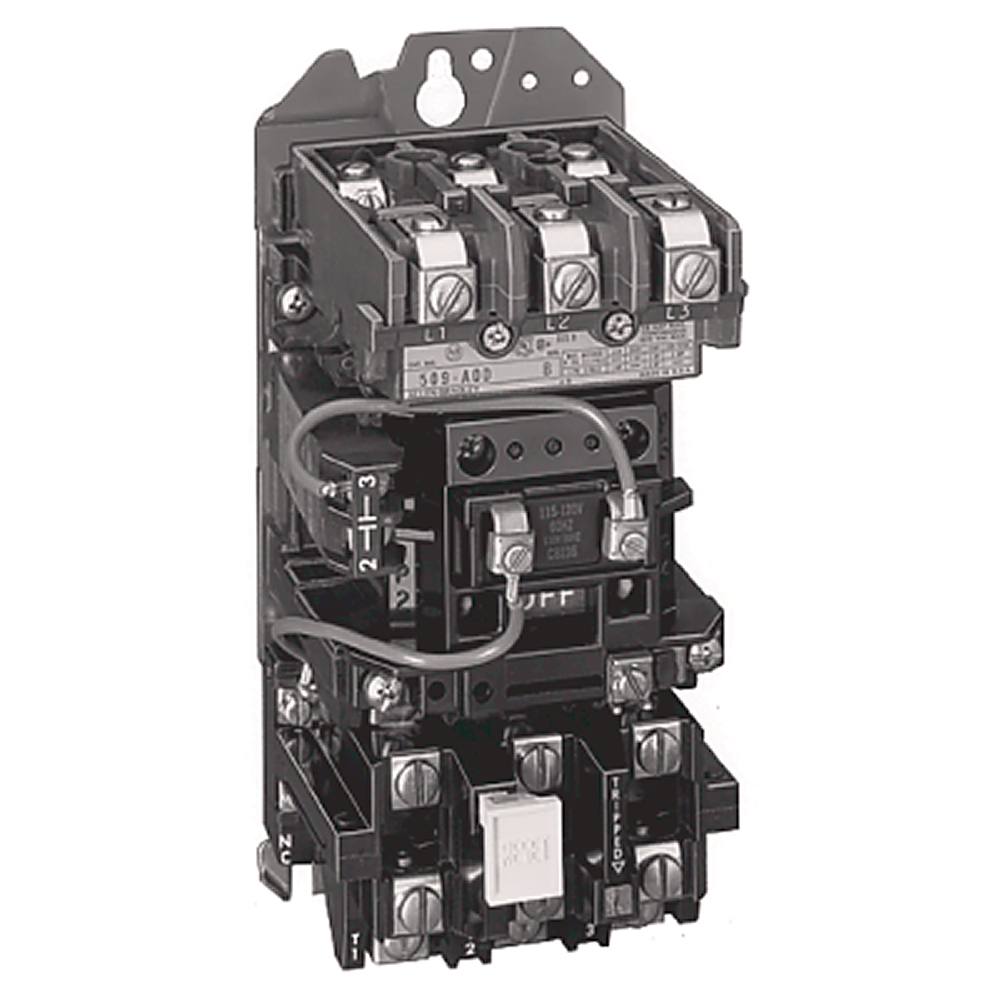
This Allen-Bradley Bulletin 509 example shows the larger assembled form many technicians associate with a traditional NEMA starter. The contactor and overload are presented as a starter selected around a standardized NEMA size.
Appearance can help identify the design approach, but it does not establish interchangeability. Confirm the NEMA size, motor horsepower and voltage, coil voltage, overload range, enclosure, duty, and coordinated protection before selecting a replacement.
What the utilization categories mean in practice
AC-1: resistive or slightly inductive loads
Typical examples include resistance heating and distribution loads. This is not the same switching duty as starting and stopping a motor.
Product example: A TeSys Deca contactor selected from its published AC-1 rating for a heater application.
AC-3: common motor starting duty
Used for squirrel-cage motors where the contactor starts the motor and opens while the motor is running, such as pumps, conveyors, compressors, and mixers.
Product example: A TeSys Deca LC1D family contactor selected by its AC-3 motor rating at the actual system voltage.
AC-4: jogging, inching, or plugging
Frequent starts, plugging, and inching impose a more severe duty. A contactor that is adequate for ordinary AC-3 service may require different sizing for AC-4 operation.
Product example: A manufacturer-rated TeSys contactor selected from the AC-4 tables, not merely from the AC-3 nameplate current.
Reversing service
Forward and reverse operation requires a properly selected reversing arrangement with suitable mechanical and electrical interlocking, overload protection, and control logic.
Product examples: Eaton Freedom reversing NEMA starters or Schneider Electric TeSys Deca reversing contactors, selected as complete arrangements.
Why IEC equipment can be smaller
A compact IEC contactor is not automatically underbuilt. It may be selected more specifically for the load and operating conditions instead of carrying the broader application margin associated with standardized NEMA sizes.
Panel advantage
A smaller footprint can reduce enclosure space, improve component layout, or reserve room for future equipment.
Selection responsibility
When the motor, duty cycle, reversing requirements, or process changes, the original selection assumptions must be checked again.
Inventory tradeoff
Closely matched IEC selections may create more distinct contactor and overload combinations. NEMA standardization may allow broader coverage with fewer starter sizes.
NEMA's extra margin can be useful
Industrial machines rarely live exactly as shown on their original drawings. Motors are replaced, loads change, and occasional operation can become frequent cycling. Additional application margin can be useful, especially where maintenance teams have standardized around a small set of starter sizes.
Eaton's Freedom NEMA family is a useful real-world example. Eaton organizes the line around standard NEMA classifications and offers contactor, starter, reversing, overload, enclosure, and accessory choices. That does not make every Freedom device interchangeable. It illustrates the NEMA sizing and maintenance philosophy.
Replacement is where the difference matters most
A failed contactor at 2:00 AM can make a physically similar spare look attractive. Before installing it, verify more than coil voltage, pole count, and current.
Load and duty
- What type of load is being switched?
- What are the motor horsepower and voltage?
- Which utilization category applies?
- How often does it operate?
- Does it jog, plug, or reverse?
Protection and coordination
- How is overload protection configured?
- What branch-circuit protection is upstream?
- What is the available fault current?
- Was the starter part of a tested or listed combination?
- Does the replacement preserve the panel's ratings?
Fit and support
- Are terminals, conductors, spacing, and heat dissipation suitable?
- Are auxiliary contacts and control functions equivalent?
- Is current manufacturer documentation available?
- Can the correct spare be stocked and identified clearly?
Coordination matters too
A motor starter is part of a system that includes the contactor, overload device, branch-circuit protection, disconnecting means, conductors, motor, and available fault current. Changing one component can affect more than normal operating current.
In a UL 508A listed panel, the short-circuit current rating depends on component ratings, combinations, and protection. A contactor with adequate horsepower and current ratings is not automatically an acceptable substitution within the combination used to establish the panel SCCR. The modification should be reviewed against the applicable manufacturer's coordination data, panel documentation, and listing requirements.
Spare parts are an engineering decision
When standardization leads
A facility with many motors may value a limited set of familiar NEMA starter sizes, documented heater or overload selections, and readily identifiable emergency spares.
When space and modularity lead
A facility with constrained enclosures and an established IEC product family may benefit from compact components, DIN-rail practices, coordinated selections, and modern configurable overloads.
Panel space, inventory, training, lifecycle support, and downtime all have a cost. Good design considers them together.
Most modern panels are already a mixture
A North American panel may use a NEMA enclosure, North American wiring conventions, IEC-style contactors, DIN-rail terminals, and products carrying multiple approvals. That is normal. The objective is not to make every component belong to one camp. It is to build a safe, maintainable system in which each component is suitable for its application.
So, should you care?
Yes, because the differences affect how equipment is selected, replaced, protected, stocked, and maintained. For a new panel, they influence component sizing, enclosure space, coordination, spare parts, and future expansion. For an existing system, they help prevent a physically compatible replacement from becoming an electrically inappropriate one.
The important part is not choosing a side. It is understanding what the ratings mean, what the application requires, and why the component belongs in the system.
How can BEA help?
BEA can review motor-control applications, identify installed components, verify load and duty requirements, evaluate overload and short-circuit protection, check current manufacturer selection data, and help develop a practical spare-parts strategy.
Whether the panel uses NEMA, IEC, or a mixture of both, we help customers make replacements and upgrades as system decisions, not part-number guesses.